
Double Towing—Here's How!
There are as many theories about double-towing as there are clouds in the sky on a windy April day. We certainly don’t claim that our method is the only correct one. But over the past two years of intensive formation flying at numerous air shows throughout Europe, we’ve worked with our regular tow pilot, Thomas Hoffmann, to optimize it step by step to the point where we’re very satisfied with the results.
The fact that two gliders are pulled up simultaneously using two ropes and a towing machine poses two significant risks. First: The gliders can collide, which is highly likely to result in major damage and possibly even a crash. The tail section is particularly vulnerable in this regard. Second: The ropes can become entangled in the models, damaging them or even tearing off a part of the model, or the lines can become so tangled that the gliders can no longer break free. The latter two scenarios usually end badly.
Observing from the ground presents another challenge: Depending on the angle and position, the models appear to cross paths behind the tow plane, making it look as though they are about to collide. Keeping your cool in that situation isn’t exactly easy. After all, depending on how the tow goes, it may not just look that way—it might actually be the case. I’ve described above what that would mean.
Our two Swifts each weigh 20 kilograms. Although the tow plane has a 200-cm³ engine and the tow pilot is very experienced, he has almost no chance of getting us safely up to altitude if we’re flying behind him poorly and out of sync. We might still manage 300 to 400 meters. But for our show, we need 600–700 meters of altitude. In addition to poor visibility, there can also be strong winds at these altitudes. Sometimes they blow in completely different directions than they do on the ground. That’s why precise flying is essential.
At large air shows, there’s the added mental strain. Performing a double tow safely in front of 30,000 spectators really puts the pilots’ nerves to the test. On top of that, weather conditions aren’t always ideal. So the goal is to find a method that works reliably and without excessive risk, even under less-than-ideal conditions.
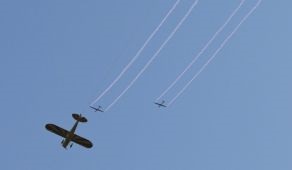
The most important aspect of our strategy is this: We don’t separate the gliders laterally, but rather by altitude and length. How does that work? We use two ropes of different lengths. A distance of 15 meters has proven to be optimal. The ropes also can’t be too short; 30 and 45 meters are ideal. The tactic is for the glider on the shorter rope to fly as high as possible, while the glider behind flies significantly lower—but not so low that the rope touches the tow plane’s elevator. The correct trim settings are crucial here. We have programmed separate trim settings for this via a flight mode switch for the tandem tow.
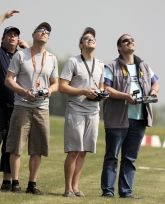
Because of this separation, it is not necessary for the two glider pilots to try to maintain a lateral distance from each other—on the contrary: the glider in the rear must fly as precisely as possible behind the glider in front. That glider, in turn, flies as precisely as possible behind the tow plane. It’s like beads on a string. Due to the vertical offset, the longer rope is always beneath the front glider.
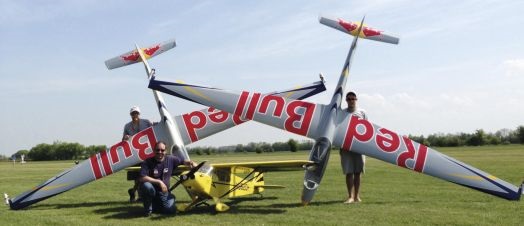
and thus cannot get tangled up in it. And since both gliders fly neatly in a line behind the tow plane, they can also avoid veering off course or cutting the route short. You can also rely on the 15-meter rope gap even during apparent crossings—that puts your mind at ease. During the tow flight, one pilot is in clear command. For us, that’s Tim, who’s attached to the front rope and, thanks to this position, has a clear view of the entire tow formation. He gives instructions on when the tow plane should make turns, whether it’s climbing too steeply and thus slowing down, or whether the formation is moving too fast.
But before the flight comes the takeoff. It’s best not to set up the models with too much lateral offset. Otherwise, they’ll be pulled too close together while taxiing on the ground. A distance of about ten to fifteen meters has proven effective. After the rollout, the front glider must take off as quickly as possible to break free from the rear glider’s tow rope. The rear glider is held on the ground until the front pilot clearly signals that he has taken off.
Once we’ve successfully reached the required altitude, we move the gliders well apart to the sides and then disengage absolutely simultaneously on command. Under no circumstances should the front glider disengage first. The 15-meter difference in rope length is then quickly used up, and there’s a loud thud. So, we wish you the best of luck with your practice.
The Red Bull Team Schaerer consists of father and son, Andi and Tim Schaerer. In addition to numerous successes as individual athletes in sailplane aerobatics at the national (a combined total of ten Swiss championship titles) and European (two European championship titles, several second- and third-place finishes) level, the two have been touring Europe for about two years as a synchronized flight team, performing at numerous air shows and events. Since 2012, Team Schaerer, along with 18 other Swiss athletes, has been part of the Red Bull Switzerland athlete team. Team Schaerer is also on Facebook:

https://www.facebook.com/pages/Team-Schaerer/150171351816134?ref=hl
*A film on the topic: http://www.youtube.com/watch?v=1YPqP3OU1pg*



News from HEBU

HORIZON HOBBY/LEMACO NEWS: MICRO OV-10 BRONCO 645 MM BY E-FLITE

PRIDE AND GOOD IDEAS
 Markus Nussbaumer

TEAM MANAGER "THIS" BOSSHARD
 Rodito Nussbaumer

YOU KNOW WHAT I MEAN? 125 YEARS OF THE SWISS AERO CLUB
 Emil Giezendanner

TRY-OUT DAY AT MFV WETTINGEN
Urs Keller
F3A EUROPEAN CHAMPIONSHIPS IN ST-MACAIRE, FRANCE
 Matthias Bosshard

ATOM, THE NEW DOUBLE-DECKER FROM CPLR
Matthias Bosshard
SUMMER FUN 2026 AT MG USTER
Martin Wunderli
What's New at Leomotion.com

52. 2026 ALPS CUP
Emil Giezendanner
TWIN TOWN PARTNERSHIP
Wolfgang Voeller
34th HAHNENMOOS ALPINE MODEL AIRPLANE CAMP
Res Dauwalder
CORSAIR F4U – A WARBIRD WITH A MEMORABLE LOOK
Jürgen Rosenberger, Jürgen Prinz
SMALL, MODEL-LIKE SAILBOATS
Res Dauwalder
WELCOME, NEW MEMBER!
Andrea Bolliger
FREE FLIGHT IN THE MIDDLE OF SUMMER
Urs Muntwyler
COUPE DES ALPES – OBSERVE AND LEARN
Rodito Nussbaumer
EURO CONTEST GLIDER ACRO TOUR AUSTRIA 2026

BY YOUTH, FOR YOUTH
Lorena Betschen
INSIGHTS INTO THE HISTORY OF SEAPLANES

THE PC-21 STORY
Emil Giezendanner
NEWS FROM HEBU
 Julia Bucher

FROM 0 TO 100
Markus Nussbaumer
MEMORIES
Wolfgang Völler
NOS REGION – A HUB FOR ELECTRIC AVIATION
Emil Giezendanner
DO YOU KNOW WHAT I MEAN IN THE LAND OF SMILES?
Emil Giezendanner
Have you almost forgotten about aircraft that take off and land vertically?
Emil Giezendanner