
Birds and Model Aircraft
A lake in the middle of a beautiful landscape. Nature and bird conservation have been a priority here for decades. Events have been taking place for a somewhat shorter time—including around and on the lake: fun runs, open-air concerts, and fireworks. Newer sports like various surfing disciplines—including kitesurfing. Stand-up paddleboarding, water skiing, and lake crossings by whole hordes of people. If all these massive, publicly authorized activities don’t disturb our waterfowl, then we model airplane enthusiasts, with our little planes and their impact, are practically negligible.
Many of our model airplane enthusiasts therefore cannot understand why we, of all people, have become the target of certain nature conservation organizations. Our flying fields—mostly green—blend seamlessly into the landscape. There are plenty of small ponds like this in every region of Switzerland. We, too, need a place to store our equipment. That makes sense, doesn’t it? Nevertheless, even for the most modest projects, we’re inundated with well-organized objections.
During our evaluations of airfield sites, we frequently come across designated protected areas without any clear indication of what is supposed to be protected. This is often the case with older municipal and cantonal designations, and even after in-depth research, it’s sometimes impossible to determine the reason. Either the animals that once lived there have long since moved on—the birds have flown away—for whatever reason, or the wetland has dried up. Why is this important to know?
Not all protected areas are “threatened” by model aircraft activities.
A paper titled “Recommendations for the Site Evaluation of New Model Airfield Locations with Regard to Nature and Landscape Conservation, Nature and Bird Conservation, mammal conservation, and hunting (expanded version 2013/2014),” it is stated that “if there is a high probability of the presence of species particularly worthy of protection and sensitive to disturbance, a flight zone closer than 500 m to the area must be avoided.” “If the flight zone is closer than 500 m to another area with a protective function, in-depth, site-specific assessments are necessary.” In one case in the NOS region, such an assessment found no changes in the animals’ behavior. Flight operations were allowed to resume with certain conditions—presumably to save face. In another case, the bird conservation organization refuses any cooperation on this matter. They do not want an assessment—it might turn out in favor of the model airplane enthusiasts... Because where ground-nesting birds are suspected to be present, a herd of cattle is grazing.
Various recommendations regarding site evaluation are said to be based on a study or investigation from 2005. As a general rule, we should treat studies the same way we treat statistics: Don’t trust any study you didn’t pay for yourself. The title of the study is “The Impact of Air Traffic on Avifauna.” To what extent the effects of air traffic also apply to model aircraft operations remains to be seen. Our
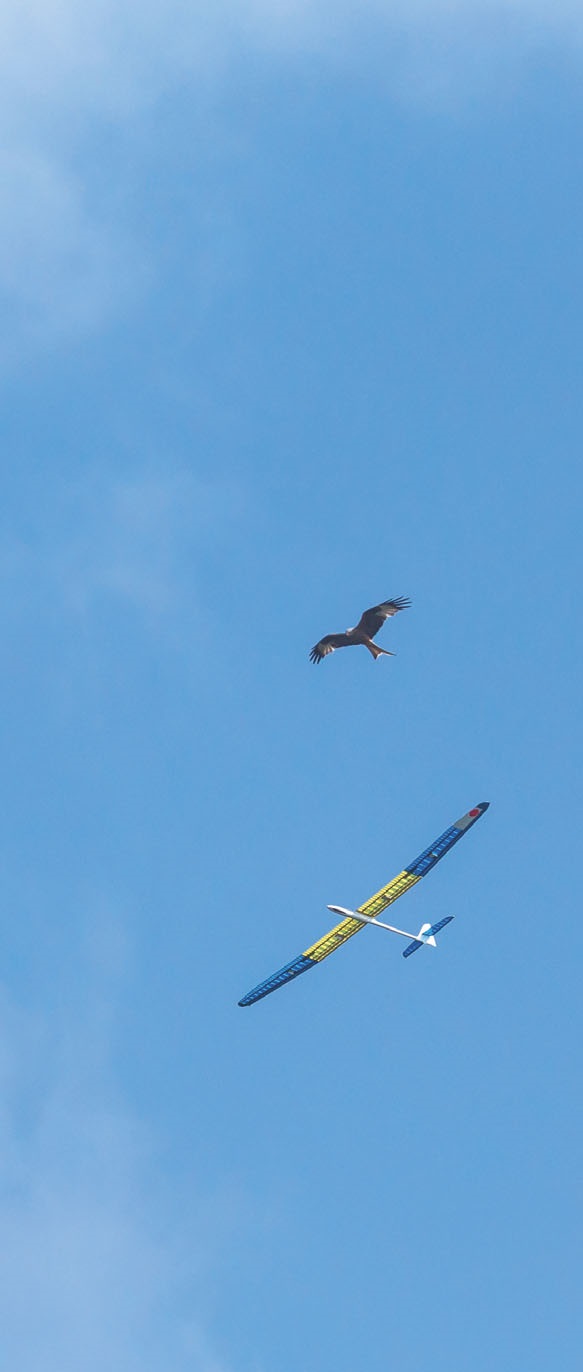
At many model airfields, birds and model airplanes coexist perfectly. This ranges from storks to birds of prey to larks. Even eagles and griffon vultures are often seen flying calmly in circles right among our model airplanes. Based on our experience, the “bird-of-prey silhouette” theory does not hold up. Observations have clearly shown that even large models—which most closely resemble birds of prey—are not perceived as mortal enemies and do not trigger a reflexive flight response. Based on these practical experiences, we now intend to compile a report. We want to collect as many examples as possible that clearly document the compatibility between birdlife and model aviation. This requires photos, the location of the observations, the time of year and time of day, bird species, etc.
Detailed information on setting up a database on the topic of “Model Aviation and Bird Life” will follow.


What's New at Leomotion.com

PRIDE AND GOOD IDEAS
 Markus Nussbaumer

News from HEBU

TEAM MANAGER "THIS" BOSSHARD
 Rodito Nussbaumer

34th HAHNENMOOS ALPINE MODEL AIRPLANE CAMP
Res Dauwalder
CORSAIR F4U – A WARBIRD WITH A MEMORABLE LOOK
Jürgen Rosenberger, Jürgen Prinz
SUMMER FUN 2026 AT MG USTER
Martin Wunderli
F3A EUROPEAN CHAMPIONSHIPS IN ST-MACAIRE, FRANCE
 Matthias Bosshard

52. 2026 ALPS CUP
 Emil Giezendanner

TWIN TOWN PARTNERSHIP
Wolfgang Voeller
EURO CONTEST GLIDER ACRO TOUR AUSTRIA 2026

BY YOUTH, FOR YOUTH
Lorena Betschen
ATOM, THE NEW DOUBLE-DECKER FROM CPLR
Matthias Bosshard
INSIGHTS INTO THE HISTORY OF SEAPLANES

YOU KNOW WHAT I MEAN? 125 YEARS OF THE SWISS AERO CLUB
Emil Giezendanner
SMALL, MODEL-LIKE SAILBOATS
Res Dauwalder
TRY-OUT DAY AT MFV WETTINGEN
Urs Keller
WELCOME, NEW MEMBER!
Andrea Bolliger
HORIZON HOBBY/LEMACO NEWS: MICRO OV-10 BRONCO 645 MM BY E-FLITE

FREE FLIGHT IN THE MIDDLE OF SUMMER
Urs Muntwyler
THE PC-21 STORY
Emil Giezendanner
COUPE DES ALPES – OBSERVE AND LEARN
Rodito Nussbaumer
NEWS FROM HEBU
 Julia Bucher

FROM 0 TO 100
Markus Nussbaumer
NOS REGION – A HUB FOR ELECTRIC AVIATION
Emil Giezendanner
MEMORIES
Wolfgang Völler
Have you almost forgotten about aircraft that take off and land vertically?
Emil Giezendanner
70 YEARS OF THE NIDWALDEN MODEL AIRPLANE CLUB
Martin Barmettler