
One of the final challenges?
The transition from stationary flight to "airplane" flight takes about ten flight sessions. The conversions, initially limited to 10° and then to 20°, are already showing good acceleration performance.
The world of model building continues to evolve every day. The construction of ready-to-fly models made of expanded foam is gradually replacing the traditional method of building with wood and fabric. In our helicopters, electronic controls are replacing the traditional control stick. LiPo batteries are competing with methanol and gasoline. Soon, there won’t be a single type of vehicle that hasn’t been replicated and made into a remote-controlled model.
One unusual aircraft, however, defied even the ingenuity of model builders. This aircraft is the V-22 Osprey, built by Bell Helicopter Textron, which is uniquely equipped with two tiltrotors at the wingtips. This configuration allows it to take off and land and to hover like a helicopter, but also—once the rotors are swiveled into a horizontal position—to fly at high speeds like a twin-engine airplane. For many RC helicopter enthusiasts, the Osprey represents one of the ultimate challenges to be mastered. And while some have already successfully flown a replica of the V-22, very few have managed to swivel the rotors more than 45°. Besides, after I found a video of the model on Rotormast.com via YouTube, I rubbed my eyes and pinched myself to make sure I wasn’t dreaming.
This small electric model can fly in any rotor configuration. It can take off, hover with astonishing ease, then tilt its rotors and fly at high speed like an airplane, before landing like a helicopter. This took place in early summer 2010. A video showed what was essentially a final prototype, the result of three years of development. Its designer, Tom Mast, is an aerospace engineer and works for Bell Helicopter Textron on the V-22 EMD project. At that time, Tom was looking for a company capable of manufacturing a kit for his model, as well as a distributor. Things fell into place fairly quickly, and I was able to place an order in the fall of 2010.
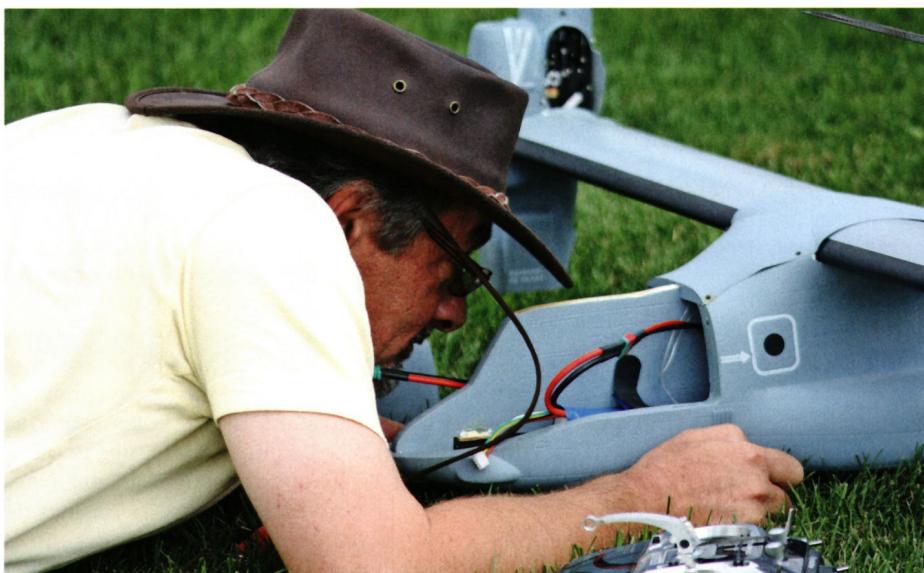
The front section of the fuselage is removed to allow access to the batteries. The black cable connects the plug-in card to the PC. The rotors are covered after the mechanical adjustments are complete. The package arrived in January—a small box containing all the parts needed to assemble the model. I ordered the motors and electronics, following the designer’s recommendations. The assembly instructions (in English) contain numerous drawings and photos that are clear enough. The documentation is very comprehensive, so the build should pose no problem for an experienced and attentive model builder. The mechanical assembly takes about 30 hours, and the fuselage about 20 hours. To perfect the authenticity of the aircraft, I installed navigation lights and an electrically retractable landing gear. The mechanical and then electronic adjustments took another good week before the rush of adrenaline for the first flight became palpable. Despite the complexity stemming from the design of the tiltrotors, Tom Mast knew from the start what the best-suited solutions were for reproducing the Osprey. Of course, there are many new technologies available for this purpose, primarily the development of electric motors and LiPo batteries. The rotational speeds of the two rotors are controlled using the “governor” function of the speed controllers. It is therefore unnecessary to include a heavy and complicated mechanical linkage. Tom immediately decided to do away with all “aircraft”-style tail surfaces. The V-22 is controlled exclusively by the cyclic and collective commands of the rotors. As a result, the aircraft requires only six servos: two for positioning the rotors and two in each rotor for the CCPM control of the swashplate. One final essential component—a specially developed electronic plug-in card—ensures the synchronization of the rotors, controls the CCPM, manages the motors of the three GY-401 gyroscopes, and, in particular, handles the inversion of aileron direction control during configuration changes. This makes it possible to achieve consistent control behavior in any flight configuration. The electronic plug-in card features a USB port. A program for Windows, downloadable remotely from the Rotormast.com website, provides access to all necessary settings and allows for hardware updates. A file containing remotely accessible parameters enables the configuration of the plug-in card using the settings specified by the manufacturer.
| Wingspan: | approx. 900 mm between the rotor axes |
| Length: | 980 mm |
| Rotors: | three-bladed, diameter 645 mm |
| Weight: | starting at 2.5 kg (standard profile version); 3.3 kg (scaled-down version with retractable landing gear) |
| Servos: | 2 Rotormast 5085 MG servos (conversion) ; 4 HS-85 servos (cyclic) |
| Motors: | Scorpion 2800 KV brushless outrunner |
| Speed controllers: | CC Ice Lite 50 |
| Gyros: | 3 GY-401 |
| Onboard Electronics: | Rotormast V-22 Controller |
| Receiver: | At least 7 channels with 90° helicopter mix, one thumbstick or rotary switch for the rotors |
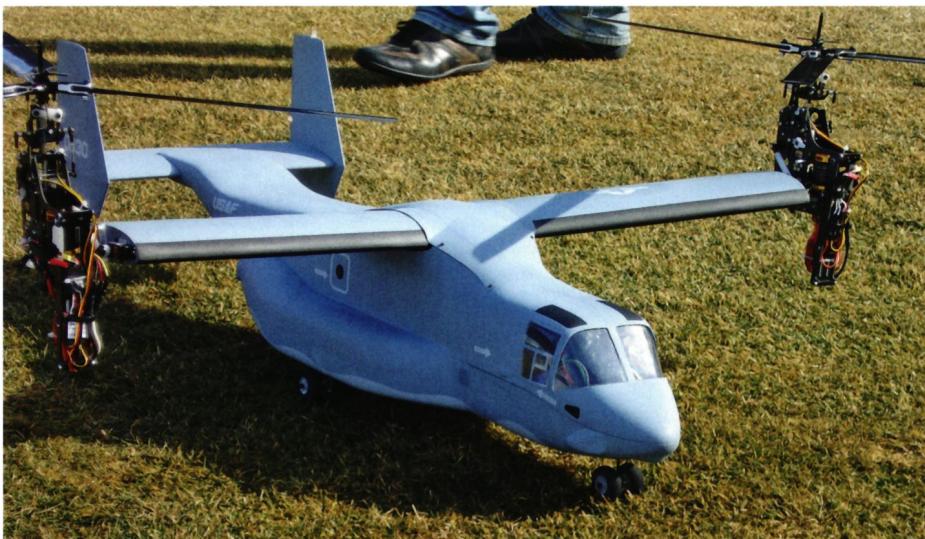
The V-22 is controlled exclusively by cyclic and collective commands for the rotors.
Once the mechanical adjustments were complete. The package arrived in January—a small box containing all the parts needed to assemble the model. I ordered the motors and electronics, following the designer’s recommendations. The assembly instructions (in English) contain numerous drawings and photos that are clear enough. The documentation is very comprehensive, so the build should pose no problem for an experienced and attentive model builder. The mechanical assembly takes about 30 hours, and the fuselage about 20 hours. To perfect the authenticity of the aircraft, I installed navigation lights and an electrically retractable landing gear. The mechanical and then electronic adjustments took another good week before the rush of adrenaline for the first flight became palpable. Despite the complexity stemming from the design of the tiltrotors, Tom Mast knew from the start what the best-suited solutions were for reproducing the Osprey. Of course, there are many new technologies available for this purpose, primarily the development of electric motors and LiPo batteries. The rotational speeds of the two rotors are controlled using the “governor” function of the speed controllers. It is therefore unnecessary to include a heavy and complicated mechanical linkage. Tom immediately decided to do away with all “aircraft”-style tail surfaces. The V-22 is controlled exclusively by the cyclic and collective commands of the rotors. As a result, the aircraft requires only six servos: two for positioning the rotors and two in each rotor for the CCPM control of the swashplate. One final essential component—a specially developed electronic plug-in card—ensures the synchronization of the rotors, controls the CCPM, manages the motors of the three GY-401 gyroscopes, and, in particular, handles the inversion of aileron direction control during configuration changes. This makes it possible to achieve consistent control behavior in any flight configuration. The electronic plug-in card features a USB port. A program for Windows, downloadable remotely from the Rotormast.com website, provides access to all necessary settings and allows for hardware updates. A file containing remotely accessible parameters enables the configuration of the plug-in card using the settings specified by the manufacturer.
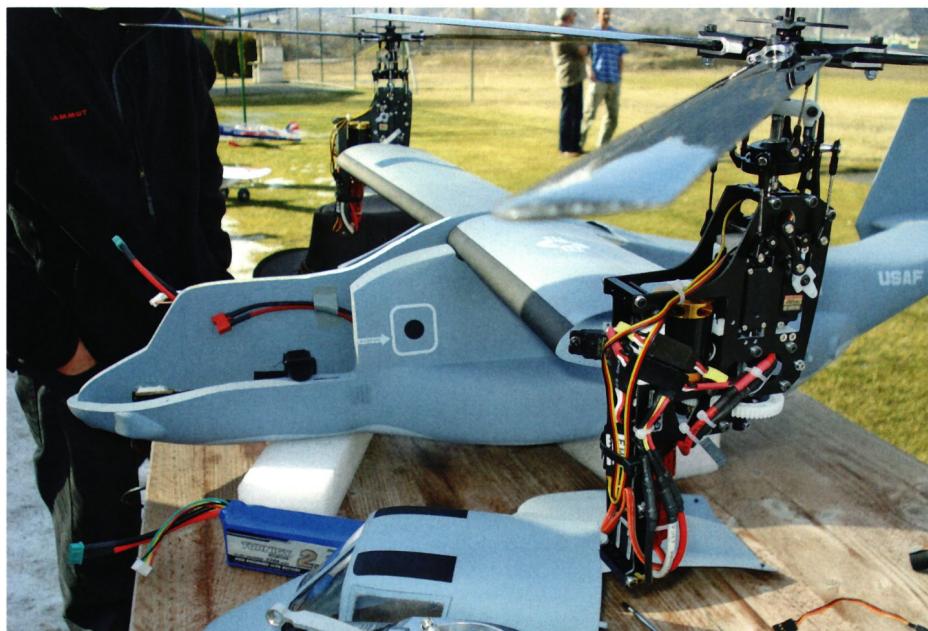
The model's parameters are programmed using an external PC. The software can be downloaded from Rotormast.
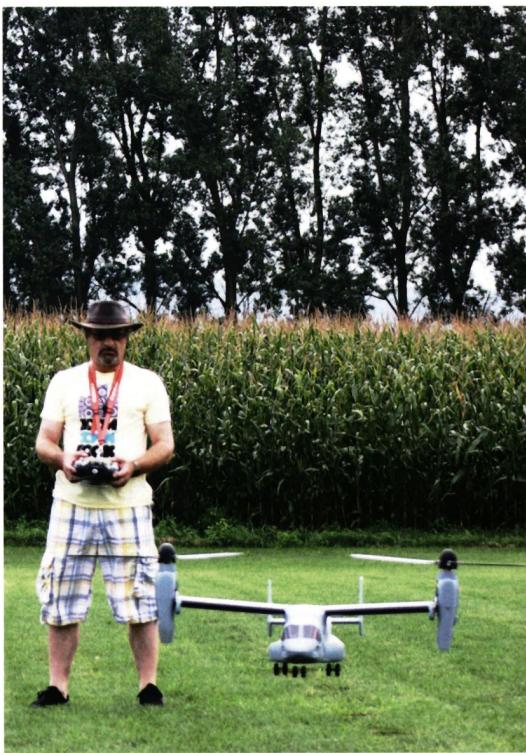
It takes a good week to complete the mechanical and then electronic adjustments before you feel the rush of adrenaline that comes before your first flight.
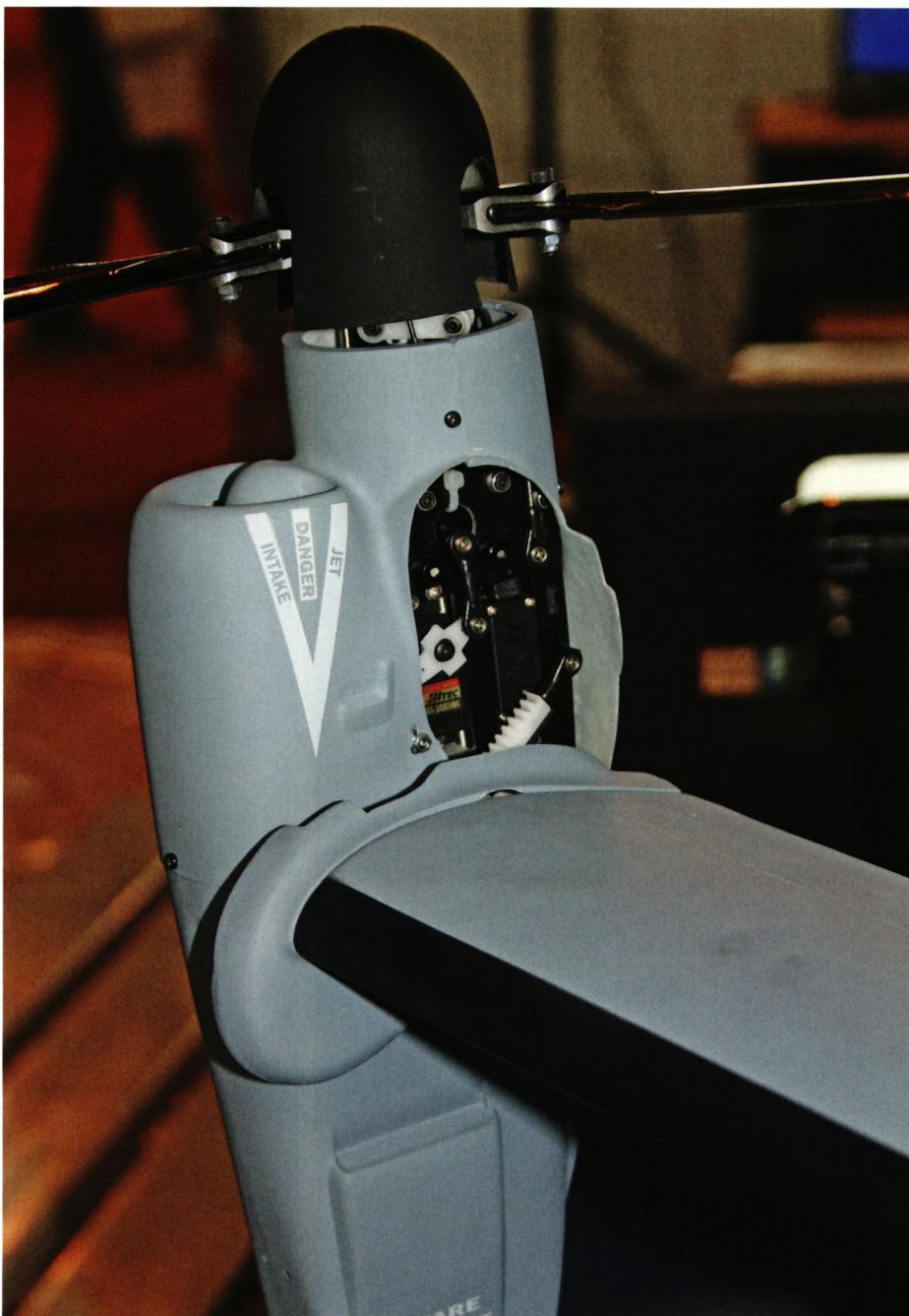
The device requires only 6 servos: 2 for positioning the rotors and 2 in each rotor for CCPM control of the cycle plate.
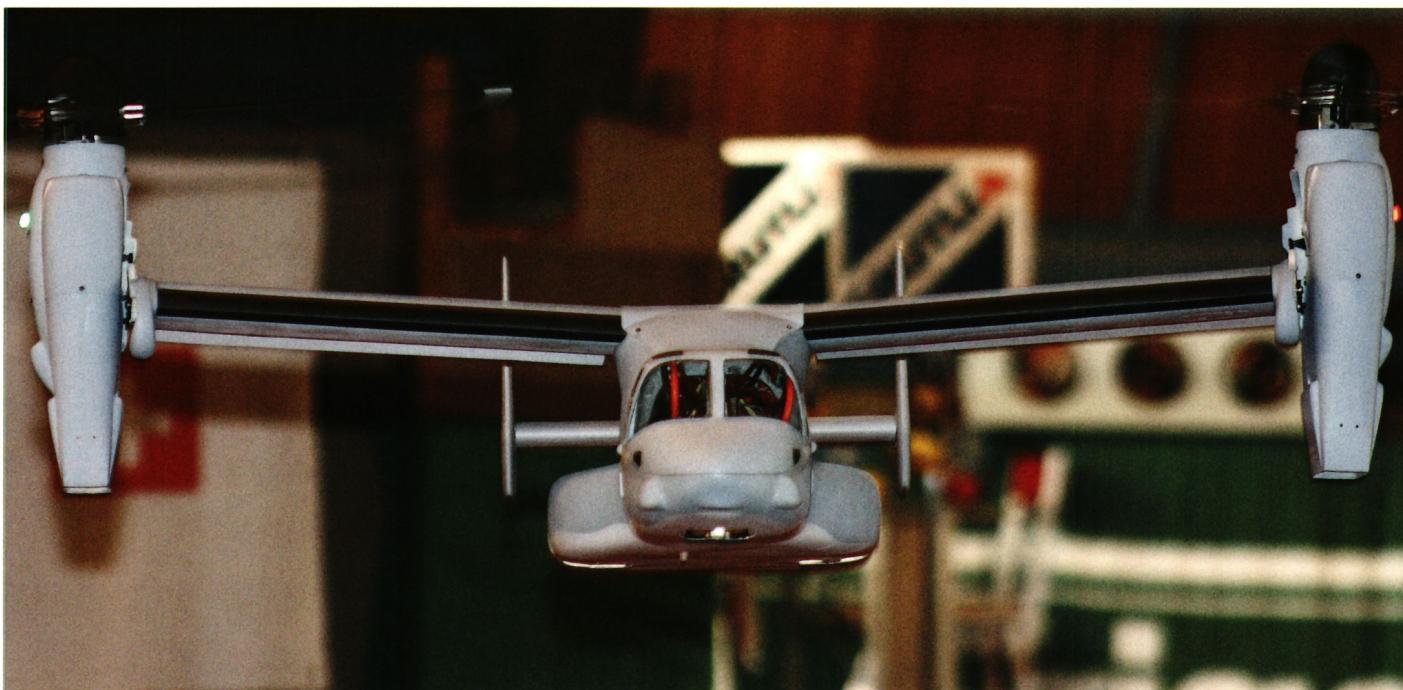
There’s no need to describe the level of excitement that precedes the first flight of such a device. After inserting and connecting the batteries (2 x 4S2200), I proceed with a final check of the controls. I position the Osprey on the runway and start the rotors. At the start, the gyros need to be calibrated, which is quickly done using the laptop. The aircraft proves to be very stable in hover. The settings need to be adjusted to accommodate my flying style; however, that’s no big deal. In translation, the V-22 behaves like a helicopter with a fixed nose. I notice a slight nose-up pitch during gusts of wind, a sign that the power output still needs to be increased. The weight of the aircraft—3.3 kg in flight configuration—requires some intervention, which is normal for a model, but the performance is still sufficient. And the initial swivel, currently limited to 10°, then 20°, already demonstrates good acceleration performance. The electronic plug-in board requires adjustment of the gyros and other parameters for each 10° step in the rotor conversion. After optimizing the settings and adjusting the control system for a given angle, the swivel lever is moved one step further, and the rotors are swiveled an additional 10°. For practice and operation, you should expect to go through about ten runs before you can switch from helicopter mode to airplane mode completely at ease.
The founder of Rotormast is Thomas Mast, an aerospace engineer who earned his degree from the University of Colorado in 1986 and has been active in the aviation industry for 25 years. A model builder since his early youth, Thomas flew his first models in the 1970s. His first helicopter was the famous Jet Ranger by Kavan. Even though it only lifted off a few dozen centimeters, Tom was hooked on scale helicopter modeling.
Over the years, Tom has flown several of the most popular models of that era, such as the Heliboy, the entire range of GMP models, several X-Cell helicopters, the TT Raptor, and, of course, the Align. Tom has built several scale models: the Bell 206, Bell 430, and Bell UH-1Z.
In 1993, Tom joined Bell Helicopter Textron, working within the Propulsion Group on the V-22 EMD program. In addition to his work on numerous successful projects, Tom was honored with the “Textron Innovation Award” in 2002 and 2005. He has written several technical articles and received a patent for a bellows-type exhaust seal that he invented.
For more information, see www.rotormast.com.


News from HEBU

TEAM MANAGER "THIS" BOSSHARD
 Rodito Nussbaumer

YOU KNOW WHAT I MEAN? 125 YEARS OF THE SWISS AERO CLUB
 Emil Giezendanner

F3A EUROPEAN CHAMPIONSHIPS IN ST-MACAIRE, FRANCE
 Matthias Bosshard

52. 2026 ALPS CUP
Emil Giezendanner
CORSAIR F4U – A WARBIRD WITH A MEMORABLE LOOK
Jürgen Rosenberger, Jürgen Prinz
SUMMER FUN 2026 AT MG USTER
Martin Wunderli
TRY-OUT DAY AT MFV WETTINGEN
Urs Keller
BY YOUTH, FOR YOUTH
Lorena Betschen
ATOM, THE NEW DOUBLE-DECKER FROM CPLR
Matthias Bosshard
SMALL, MODEL-LIKE SAILBOATS
Res Dauwalder
What's New at Leomotion.com

HORIZON HOBBY/LEMACO NEWS: MICRO OV-10 BRONCO 645 MM BY E-FLITE

COUPE DES ALPES – OBSERVE AND LEARN
Rodito Nussbaumer
TWIN TOWN PARTNERSHIP
Wolfgang Voeller
PRIDE AND GOOD IDEAS
 Markus Nussbaumer

EURO CONTEST GLIDER ACRO TOUR AUSTRIA 2026

INSIGHTS INTO THE HISTORY OF SEAPLANES

34th HAHNENMOOS ALPINE MODEL AIRPLANE CAMP
Res Dauwalder
WELCOME, NEW MEMBER!
Andrea Bolliger
FREE FLIGHT IN THE MIDDLE OF SUMMER
Urs Muntwyler
THE PC-21 STORY
Emil Giezendanner
NEWS FROM HEBU
 Julia Bucher

FROM 0 TO 100
Markus Nussbaumer
MEMORIES
Wolfgang Völler
NOS REGION – A HUB FOR ELECTRIC AVIATION
Emil Giezendanner
Have you almost forgotten about aircraft that take off and land vertically?
Emil Giezendanner
DO YOU KNOW WHAT I MEAN IN THE LAND OF SMILES?
Emil Giezendanner