
When you don't have a reflex, balsa, or Sagex?
What if I went back to when I was 12–15 years old to rediscover model aircraft flying on my own... given today's technology and limited resources, what would be the best option? Is a ready-to-fly model airplane really the best option?
Many modelers started out with a free-flight glider: this educational approach has the advantage—in addition to its low cost—of preparing a young pilot for the challenges of building, tuning, and repairing that will accompany them throughout their career. As for flight stability, what could be better than a free-flight glider? We all remember Graupner’s Kleine Uhu. So I bought the kit for the bargain price of 36 francs. But here’s the thing: we’re now in the age of radio control.
To convert our free-flight glider into an RC glider, we’ll need some CTP Aviation parts (about 6 francs), 4 servos at 4 francs each, and a 2S/250 mAh LiPo battery for 4 francs. We’ll cover the airframe with heat-shrink tubing and use a used 2.4 GHz transmitter and receiver purchased for 40 francs on a well-known Swiss auction site, along with a charger for a similar price.
In summary, 140 francs and between 5 and 10 hours of construction time were invested in an aircraft that could allow a beginner to try their hand at a few short flights.
Flight tests are conducted at the GAM Geneva airfield. The first flights confirmed that the model was a wise choice. Flight stability is remarkable, provided the trim specifications are followed. Flight speed is slow, and stalling is impossible. The controls are responsive (I recommend increasing the rudder surface area by at least one-third) but with the inertia of a true heavyweight. I would therefore conclude that the Uhu is perfectly suited for those trying their hand at RC flying.
But how can we increase flight time? Catapulting or electric motorization?
A bungee cord made from 15 meters of elastic cord purchased at a home improvement store (2.–/meter, or CHF 30.–), 30 meters of clothesline, a ring, and a tent stake costs about forty francs and allows us to launch the 190-gram Uhu to an altitude of about 30 meters and keep it gliding for about twenty seconds (both in a straight line and when turning). The electric solution requires the purchase of a brushless motor designed for indoor aircraft (1,500 rpm/V) (CHF 10.– to 15.–), a 6-amp ESC (CHF 10.– to 15.–), and a
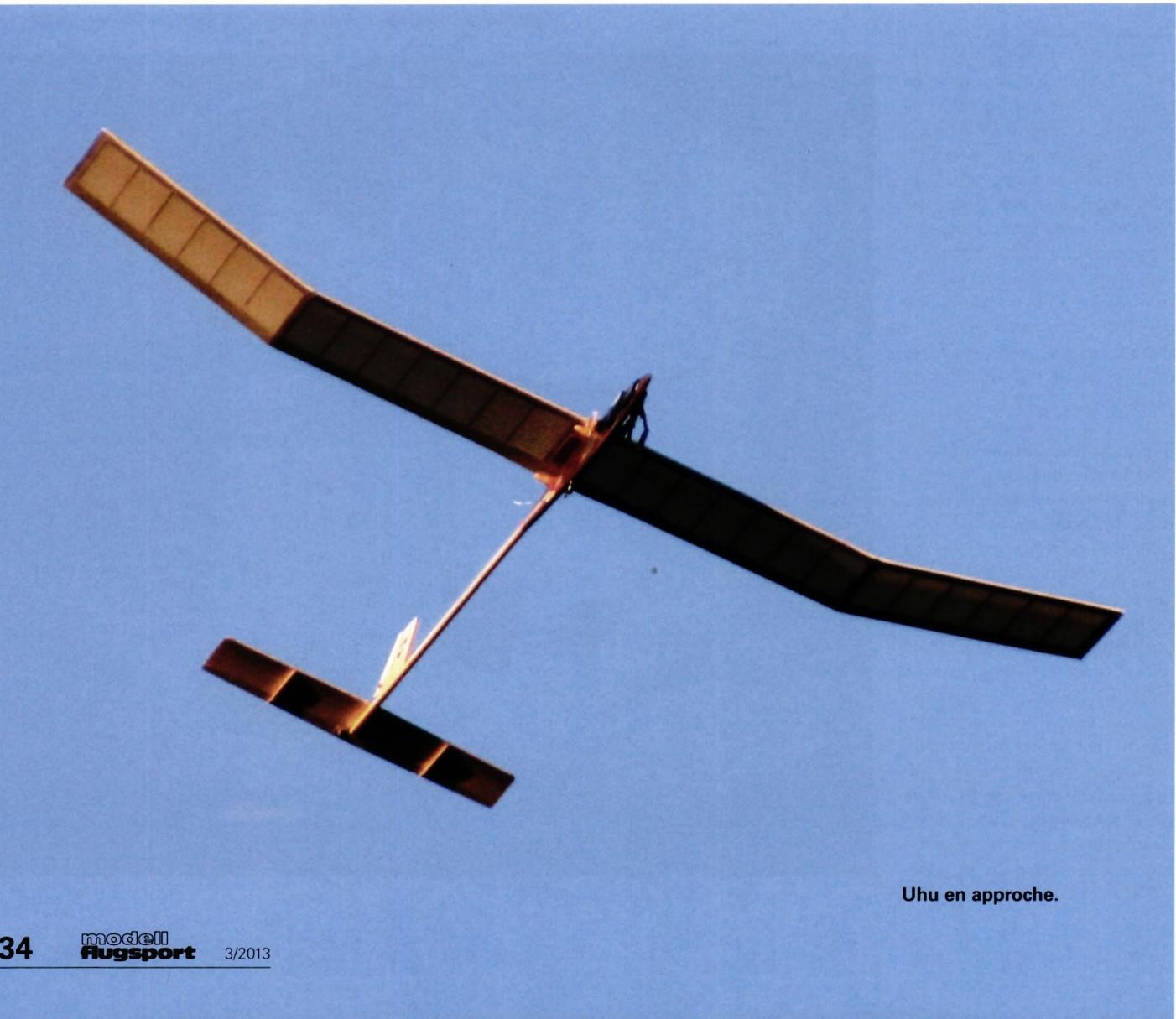
GWS 8×4.3 propeller (CHF 4.–) and a few minor modifications to the airframe. In this configuration, the Uhu proves to be a very pleasant motor glider. The power is more than enough to lift our 235-gram “nuclear” glider almost vertically, and the motor runs for two to three minutes.
Another affordable way to try out this hobby is through clubs that offer free or paid introductory sessions. For a beginner, it’s better to invest in a ready-to-fly (RTF) model equipped with a gyroscope, charger, transmitter, and battery than to try building a custom free-flight glider from scratch. For ten or twenty francs more or less, you can buy RTF (Ready-to-Fly) Sagex kits that are less fragile and easy to repair.
But assuming that the dad is a modeler and would like to introduce his children to this hobby, the free-flight glider is the best option. That way, you don’t have to spend extra on a remote control or charger. There are always some scraps of balsa or plywood and leftover fabric in the workshop. For an educational approach, this remains the best solution.
Enjoy the read, and best regards from the modeling community.
François Ballis, GAM Geneva


News from HEBU

TEAM MANAGER "THIS" BOSSHARD
 Rodito Nussbaumer

YOU KNOW WHAT I MEAN? 125 YEARS OF THE SWISS AERO CLUB
 Emil Giezendanner

PRIDE AND GOOD IDEAS
 Markus Nussbaumer

ATOM, THE NEW DOUBLE-DECKER FROM CPLR
 Matthias Bosshard

SUMMER FUN 2026 AT MG USTER
Martin Wunderli
F3A EUROPEAN CHAMPIONSHIPS IN ST-MACAIRE, FRANCE
Matthias Bosshard
52. 2026 ALPS CUP
Emil Giezendanner
HORIZON HOBBY/LEMACO NEWS: MICRO OV-10 BRONCO 645 MM BY E-FLITE

TWIN TOWN PARTNERSHIP
Wolfgang Voeller
CORSAIR F4U – A WARBIRD WITH A MEMORABLE LOOK
Jürgen Rosenberger, Jürgen Prinz
TRY-OUT DAY AT MFV WETTINGEN
Urs Keller
WELCOME, NEW MEMBER!
Andrea Bolliger
EURO CONTEST GLIDER ACRO TOUR AUSTRIA 2026

BY YOUTH, FOR YOUTH
Lorena Betschen
INSIGHTS INTO THE HISTORY OF SEAPLANES

SMALL, MODEL-LIKE SAILBOATS
Res Dauwalder
What's New at Leomotion.com

COUPE DES ALPES – OBSERVE AND LEARN
Rodito Nussbaumer
34th HAHNENMOOS ALPINE MODEL AIRPLANE CAMP
Res Dauwalder
FREE FLIGHT IN THE MIDDLE OF SUMMER
Urs Muntwyler
THE PC-21 STORY
Emil Giezendanner
NEWS FROM HEBU
 Julia Bucher

FROM 0 TO 100
Markus Nussbaumer
MEMORIES
Wolfgang Völler
NOS REGION – A HUB FOR ELECTRIC AVIATION
Emil Giezendanner
Have you almost forgotten about aircraft that take off and land vertically?
Emil Giezendanner
DO YOU KNOW WHAT I MEAN IN THE LAND OF SMILES?
Emil Giezendanner