
"Traumschiff" EB29R 1:3.5 by Richi Oberholzer
Upon returning from an extended test flight, a successful Danish competition pilot described the EB29R as a "dream plane."
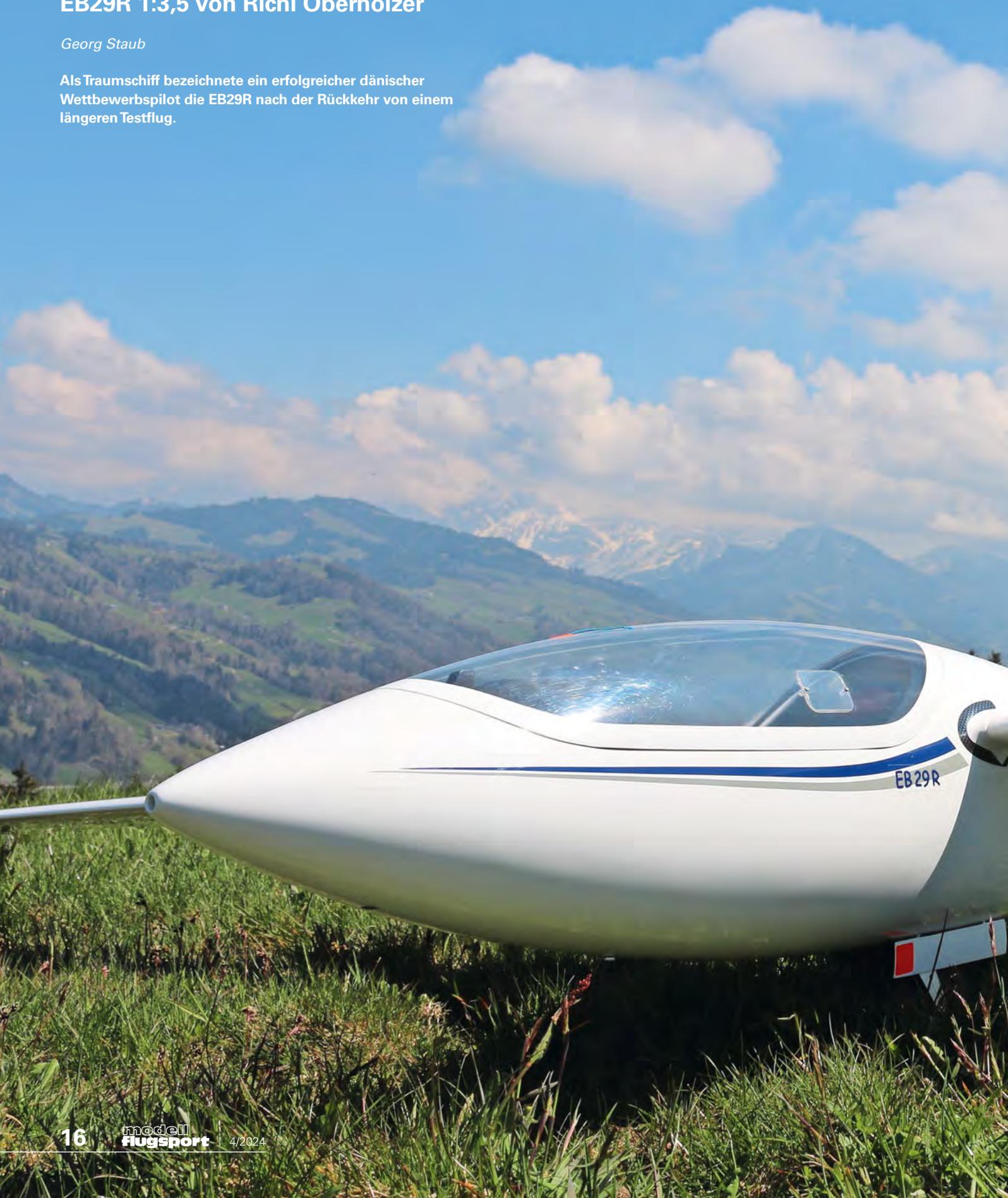
In addition to its fantastic glide performance at 200 km/h, he had been impressed by the “giant bird’s” astonishingly agile handling and climb rate in weak thermals. Richi Oberholzer had long dreamed of building and flying such a “super orchid” as a model airplane. Ultimately, it was a short video clip showing two EB29s landing in the evening light that inspired Richi to make his dream a reality.
Since his youth, Richi has been building model gliders, which he flies almost exclusively on slopes. With few exceptions, these were faithful replicas of modern gliders, primarily on a 1:3.5 scale. But he also built vintage gliders from the plywood era, including the unconventional Hütter H-28 from 1937. In addition to its temperamental flight characteristics, it stands out for its distinctive, stocky fuselage shape. The latter has earned it the nickname “Pouletschenkeli.”
Twenty years ago, I had the chance to work with Richi on our first joint project: the Diana 1 on a 1:3.5 scale. This was followed by further joint projects. Later, Andi Schwerzmann and finally Jürgen Lefevere joined the team. Each of us built our own plane but benefited from the preparatory work done individually or in pairs (such as cutting all the Styrofoam wing cores, building the fuselage mold, and constructing the fuselages) as well as from the experience and specialized knowledge of our teammates. This explains why a new project, produced in four copies, could often be completed in less than a year.
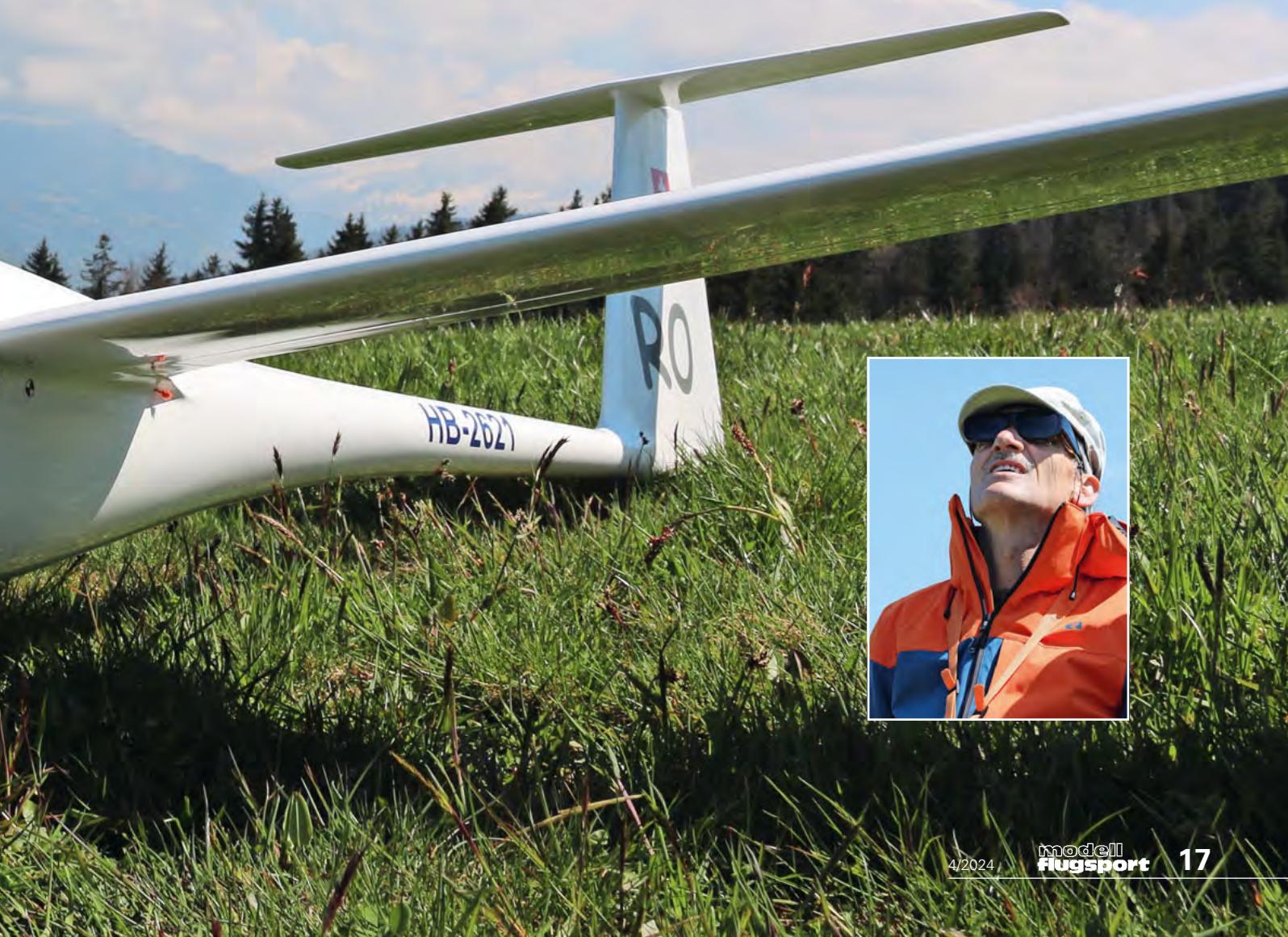
Since the transition from the plywood era to the plastic era, the fuselage shapes of passenger gliders have become difficult for a layperson to distinguish from one another. Often, the differences lie only in details, such as the shape of the canopy opening or the outline of the vertical stabilizer.
Richi’s interest has always been in gliders with a unique fuselage shape or those that had never been built as models. It was almost always Richi who discovered these and then proposed them to us as new projects. Some were new designs that had not yet made their maiden flight; others were known only to insiders at that time, such as the Diana 2, SB-14, and JS 3. The latter flew so convincingly as models that the company Chocofly later took over their mass production.
Building the fuselage positives has always been Richi’s job. He has now built eleven master molds, which are indispensable for the production of fuselage negatives. Building such a master mold by hand isn’t for everyone. It requires a highly developed sense of form and design, as well as a trained eye. As a trained goldsmith, Richi possesses these skills.
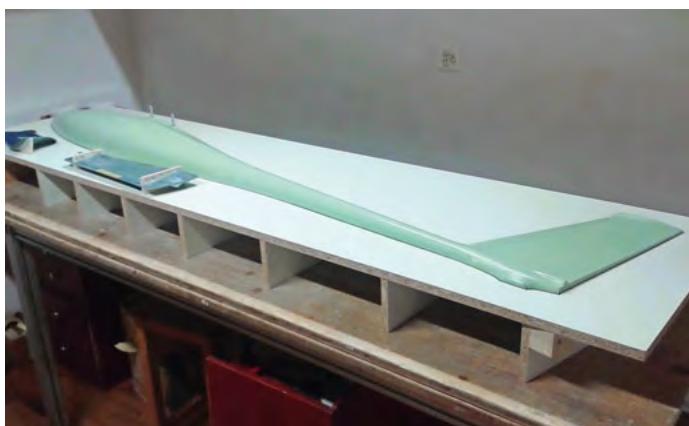
He works with very simple tools. His method can only be briefly summarized here. Richi transfers the fuselage outline—from a side view scaled up to the model’s dimensions—onto blocks of rigid foam that have been mounted on a carbon-fiber support tube. This contour is cut out with a band saw. In the same way, the dimensions of the top view are transferred to the hard foam. Next comes the shaping—carving out the final form from the foam block by hand using sanding blocks of varying lengths. This demanding work can be compared to that of a sculptor. It requires a trained, unerring eye and a patient approach. The accuracy of the model and the symmetry of the fuselage cross-sections must be continuously checked using negative templates. After applying a layer of fiberglass cloth, the canopy area is cut out, the separately manufactured vertical stabilizer is glued to the fuselage tube, and the wing attachment ribs are installed. This is followed by several rounds of fine-filling, spray-filling, sanding, checking, more sanding, filling, and checking—a dusty, tedious, and very time-consuming process. It requires a great deal of patience and perseverance. It’s worth the effort, though, because even the tiniest dent would show up later on the finished high-gloss fuselage.
| Fuselage length: | 237 cm |
| Wing area: | 128.65 dm² |
| Wing root profile: | HN-474 mod. (12% thickness, 2.11% camber) |
| Number of flaps: | 8 |
| Weight: | 8,000 g |
| Wing loading: | 62 g/dm² |
After applying several coats of release wax, the hull positive is finally ready for casting—that is, for the construction of the negative mold. Some readers may have smiled while reading this description. Even Richi is aware that his work method is outdated. Digital technology, CNC milling, and 3D printers now make it possible to machine a hull positive much faster and with much greater dimensional accuracy. However, this requires either having access to this technology yourself or being willing to have the work done by a specialized company for an appropriate fee.
Starting in 1974, the company Binder Flugmotoren- und Flugzeugbau in Ostheim vor der Rhön began developing folding engines for the self-launch of gliders. Over the years, the company’s founder, Walter Binder—himself a passionate glider pilot—focused on designing single- and two-seat, self-launching performance gliders in the Open Class. His ambitious goal was to create the world’s best performance glider. Starting with an ASH 25, the company succeeded in continuously improving the performance of the “Superorchideen” models in its own Binder EB28 and EB29 series through constant optimization. Between 2010 and 2018, the EB29 took first place several times at world championships. In 2016, Binder introduced the EB29R (R for Race). This is a comprehensive further development of the Binder EB29, which could be flown with various wingspans. For the R version, a new, even slimmer wing with a 28-meter wingspan was designed, featuring a significantly thinner profile and a very high aspect ratio of 1:53. Incidentally, the same wing is also used on the EBDP two-seater, which features an extended fuselage. However, space is still very limited in the rear seat, which is offset to the side; for this reason, the designer refers to it as a “1.5-seater.” The EB29R ranks among the best gliders in the world. It flies at a fast approach speed of over 200 km/h with very low sink rate from updraft to updraft—about 20 km/h faster than the competition. Its best glide ratio is around 66. These performance figures are thus comparable to those of Dick Butler’s one-of-a-kind Concordia, which also has a 28-meter wingspan and a calculated glide ratio of over 70.
Richi decided to build the EB29R in the tried-and-true 1:3.5 scale. He carried out this project entirely on his own. The goals he set were clearly defined. His EB29R was supposed to climb very well even in weak thermals and circle as independently as possible. The wings were to be lightweight, and the detachable outer wing, in particular, was to flex during flight just like the full-scale model, thereby signaling when the glider was entering a thermal. A high maximum speed was not a priority, which is why the option of adding ballast was omitted.
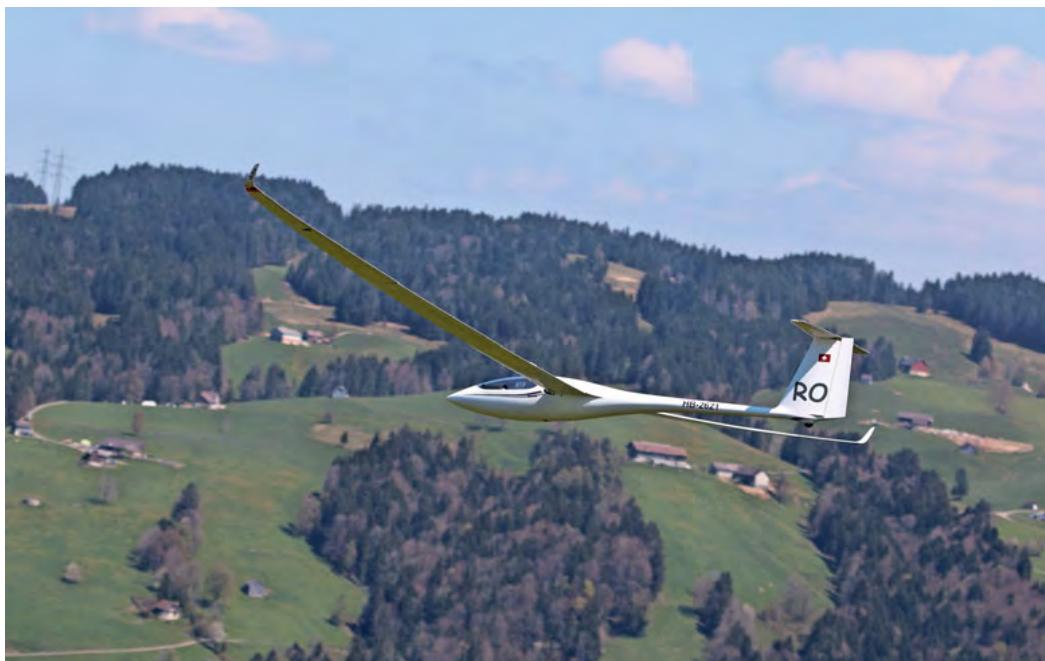
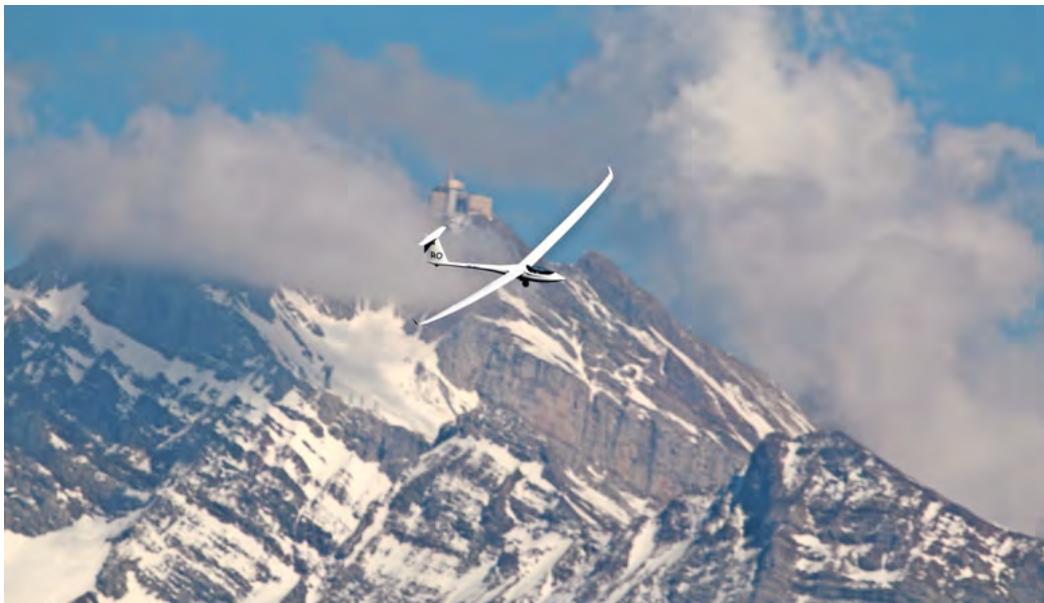
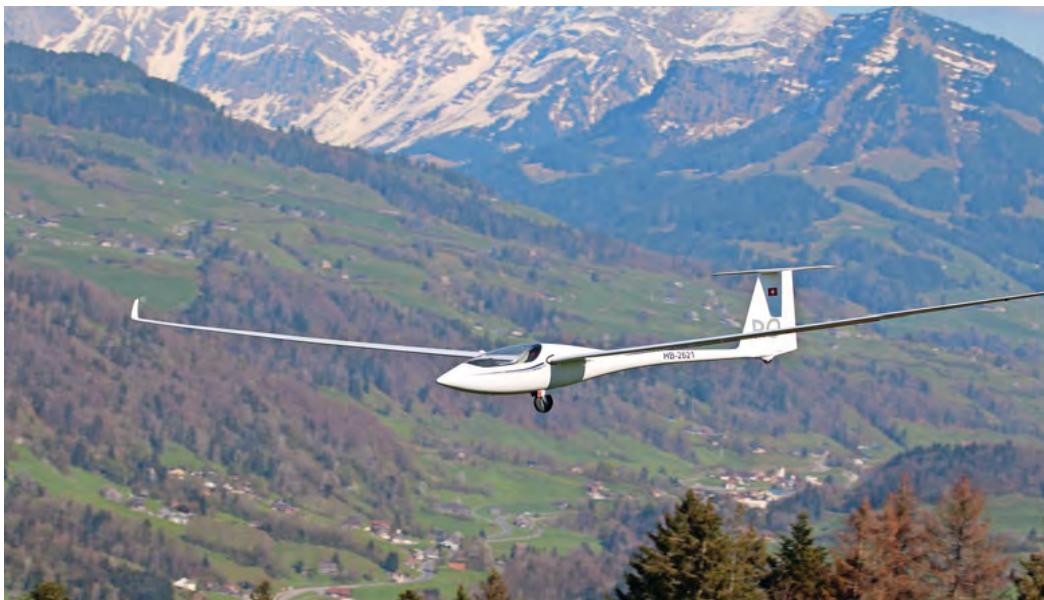
Anyone who has seen Richi’s EB29R will confirm that these goals have largely been achieved. The glider has turned out beautifully. It glides majestically, circles slowly and tightly even with a strong crosswind, and is indistinguishable from the original in flight. On the ground, the EB29R impresses with its perfect finish and the extremely realistic cockpit interior, which Richi values highly. The ever-modest Richi doesn’t make a big deal out of his work. Like many perfectionists, he is never entirely satisfied with the result. In late 2022, Richi described the development of his project and the flight characteristics of the EB29R to me in an interview.
How did you come to build this aircraft?
I’ve always been fascinated by Open Class gliders, with their long aspect ratios and tremendous performance. A few years ago, I came across an article in a gliding magazine that featured the EB29R. Later, I saw this glider in a video from the World Championships in Australia. After a competition flight, the Open Class gliders arrived at the airfield in a group, including two EB29Rs piloted by Germans. You could see these two gliders gliding in against the evening backlight with their wings arched, in the spray of the water ballast being jettisoned—beautiful! This almost mystical atmosphere and the unique perspective completely captivated me and stayed with me ever since. I just had to build the EB29R!
A project like this required documentation. What materials did you have available?
I wrote to the company Binder Flugzeugbau and received a three-view drawing. In my thank-you letter, I honestly wrote that it might take years for my model to be completed—which is exactly what happened.
How long did it take to build your model?
About three years, with breaks. I started the fuselage master model in 2018. At the same time, I was also working on the master model of the JS3—our team project at the time. With the EB29R, I had the problem that I didn’t have very good reference materials. A fuselage cross-section was missing from the three-view drawing. Many details—for example, the contour of the cockpit opening—didn’t match up with the photos and video clips. A lot of time went into researching and redrawing until I had a fuselage representation that matched the photos as closely as possible. It really bothers me when I realize afterward that my fuselage has a flaw. Ultimately, though, I felt that it fit together quite well, and I was ready to get started.
Who designed the fuselage shape and built the fuselage?
I built it all by myself. Creating the master mold, building the parting line, and fitting the master mold, then laminating layer by layer—just the way you’re supposed to do it...
How did the concept for the wings and tail surfaces come about?
You suggested the airfoil profile and dealt with the structural analysis. That was a huge help to me.
When choosing a profile, it’s important to know what you ultimately expect from the aircraft. What did you prioritize?
Since the wing has an enormous aspect ratio, high torsional stiffness was very important. A very thin profile was out of the question, also for structural reasons. With a “decent” spar height, the weight can be kept low. We opted for a profile with slightly more camber than usual. After all, the goal wasn’t to be able to zoom around at 250 km/h with this big bird with an eight-meter wingspan. We aimed for good glide and climb performance in thermals. The goal was recreational flying; it was achieved. The EB29R has turned out to be a superb aircraft. While handling on the ground is a bit cumbersome, it’s fantastic in the air.
How much does your EB29R weigh?
Eight kilograms. Based on my flying experience, I believe the inner wing could have been built lighter. It was designed to handle a higher weight.
When was the maiden flight?
On April 1, 2021, at the MG Gossau airfield, towed by a fixed-wing aircraft.
How would you describe its flight characteristics and performance?
They’re incredible. Even in very light updrafts, the EB29R takes off immediately in tight, steep circles. I limit the maximum speed to 150 km/h to prevent overloading. I can’t just invert the EB29R to lose altitude efficiently. Since I’ve omitted dive brakes, I can only brake using the butterfly.
Isn’t the EB29 very sluggish because of its size?
Not at all. I can also fly very tight turns; it turns practically on its own.
How do you launch the EB29 from a hillside?
By hand. With a bit of a headwind, it takes off after just a few steps. The weight isn’t the problem—it’s controlling the glider during takeoff. If the EB29R gets caught in a gust during a race, I can’t correct it by hand before letting go of the glider because of its inertia. That led to a takeoff accident in the summer of 2022. I saw my colleagues climbing in the thermal just in front of the launch site and was determined to take advantage of that thermal as well. Because I hadn’t carefully checked the wind direction, I didn’t realize that the wind was currently coming diagonally from the front left. I took off, but the EB29R was unable to reach its minimum speed. Nevertheless, I had to let go of it. It then hung in the air in front of me in a stall, practically uncontrollable, drifted off to the right, and struck the ground first with the right wingtip and then with the tip of the fuselage. The wing connectors on the outer wings broke, and several cracks appeared in the fuselage near the canopy. I was lucky—the damage has since been repaired.
Would you like to add anything else?
I plan to build the EB29R again, with a slightly shorter wingspan and a lighter in-wing structure. This airplane just fascinates me. In its original form, it’s the best single-seater in the Open Class, wins almost every competition, and has even set a world record.
What I don’t want to include is the retractable engine, which is standard on Binder models.
Sources:
Aerokurier 7/2017
https://binderflugmotorenbau.de
Images: Jürgen Lefevere


News from HEBU

TEAM MANAGER "THIS" BOSSHARD
 Rodito Nussbaumer

SUMMER FUN 2026 AT MG USTER
Martin Wunderli
SMALL, MODEL-LIKE SAILBOATS
Res Dauwalder
TRY-OUT DAY AT MFV WETTINGEN
Urs Keller
What's New at Leomotion.com

52. 2026 ALPS CUP
 Emil Giezendanner

ATOM, THE NEW DOUBLE-DECKER FROM CPLR
 Matthias Bosshard

INSIGHTS INTO THE HISTORY OF SEAPLANES

YOU KNOW WHAT I MEAN? 125 YEARS OF THE SWISS AERO CLUB
Emil Giezendanner
34th HAHNENMOOS ALPINE MODEL AIRPLANE CAMP
Res Dauwalder
CORSAIR F4U – A WARBIRD WITH A MEMORABLE LOOK
Jürgen Rosenberger, Jürgen Prinz
F3A EUROPEAN CHAMPIONSHIPS IN ST-MACAIRE, FRANCE
Matthias Bosshard
HORIZON HOBBY/LEMACO NEWS: MICRO OV-10 BRONCO 645 MM BY E-FLITE

PRIDE AND GOOD IDEAS
 Markus Nussbaumer

BY YOUTH, FOR YOUTH
Lorena Betschen
FREE FLIGHT IN THE MIDDLE OF SUMMER
Urs Muntwyler
THE PC-21 STORY
Emil Giezendanner
TWIN TOWN PARTNERSHIP
Wolfgang Voeller
EURO CONTEST GLIDER ACRO TOUR AUSTRIA 2026

WELCOME, NEW MEMBER!
Andrea Bolliger
COUPE DES ALPES – OBSERVE AND LEARN
Rodito Nussbaumer
NEWS FROM HEBU
 Julia Bucher

FROM 0 TO 100
Markus Nussbaumer
MEMORIES
Wolfgang Völler
NOS REGION – A HUB FOR ELECTRIC AVIATION
Emil Giezendanner
Have you almost forgotten about aircraft that take off and land vertically?
Emil Giezendanner
70 YEARS OF THE NIDWALDEN MODEL AIRPLANE CLUB
Martin Barmettler