
MEMORIES
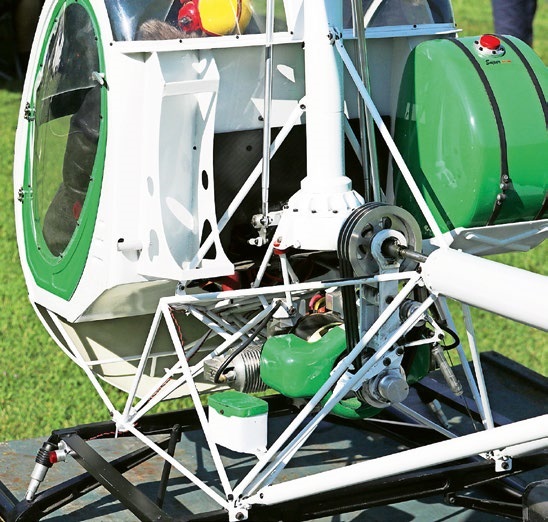
The engine mechanics—including the rotor—of a helicopter are a small marvel.
Good morning, it's summer again and it's very hot outside.
All the more reason to take a little time to enjoy a cold drink and admire the helicopter’s engine.
The propulsion system consists of an engine and a rotor. Simply put, the rotor acts as both a wing and a propeller.
This means it must provide lift while also ensuring forward motion.
The rotor blades have a profile similar to that of a propeller. As it rotates, the rotor consists of multiple blades. At a minimum of two, the pilot’s controls adjust the device to an angle that allows for the desired movement. This is achieved via the so-called swashplate.
Since this creates a rotational movement, a tail brake is needed to counteract this force. This is achieved using a small rotor or, as in the case of the Kamov, via two “side rudders” and two counter-rotating main rotors.
The rotor’s rotational speed remains constant during flight. In model helicopter construction, there are various propulsion systems—from electric to turbine-powered—that are technically identical to the originals, only smaller.
It’s worth visiting an event to check out the models and admire the technology.
With that in mind, I wish you all a wonderful summer and look forward to welcoming you back to our late-summer events.

Scale Model Details.
Engine and transmission views.

TEAM MANAGER "THIS" BOSSHARD
 Rodito Nussbaumer

F3A EUROPEAN CHAMPIONSHIPS IN ST-MACAIRE, FRANCE
 Matthias Bosshard

News from HEBU

YOU KNOW WHAT I MEAN? 125 YEARS OF THE SWISS AERO CLUB
 Emil Giezendanner

SUMMER FUN 2026 AT MG USTER
Martin Wunderli
TRY-OUT DAY AT MFV WETTINGEN
Urs Keller
52. 2026 ALPS CUP
Emil Giezendanner
BY YOUTH, FOR YOUTH
Lorena Betschen
ATOM, THE NEW DOUBLE-DECKER FROM CPLR
Matthias Bosshard
CORSAIR F4U – A WARBIRD WITH A MEMORABLE LOOK
Jürgen Rosenberger, Jürgen Prinz
SMALL, MODEL-LIKE SAILBOATS
Res Dauwalder
What's New at Leomotion.com

TWIN TOWN PARTNERSHIP
Wolfgang Voeller
EURO CONTEST GLIDER ACRO TOUR AUSTRIA 2026

INSIGHTS INTO THE HISTORY OF SEAPLANES

34th HAHNENMOOS ALPINE MODEL AIRPLANE CAMP
Res Dauwalder
HORIZON HOBBY/LEMACO NEWS: MICRO OV-10 BRONCO 645 MM BY E-FLITE

COUPE DES ALPES – OBSERVE AND LEARN
Rodito Nussbaumer
PRIDE AND GOOD IDEAS
 Markus Nussbaumer

FREE FLIGHT IN THE MIDDLE OF SUMMER
Urs Muntwyler
THE PC-21 STORY
Emil Giezendanner
WELCOME, NEW MEMBER!
Andrea Bolliger
NEWS FROM HEBU
 Julia Bucher

FROM 0 TO 100
Markus NussbaumerMEMORIES
Wolfgang Völler
NOS REGION – A HUB FOR ELECTRIC AVIATION
Emil Giezendanner
Have you almost forgotten about aircraft that take off and land vertically?
Emil Giezendanner
70 YEARS OF THE NIDWALDEN MODEL AIRPLANE CLUB
Martin Barmettler